Event Recap
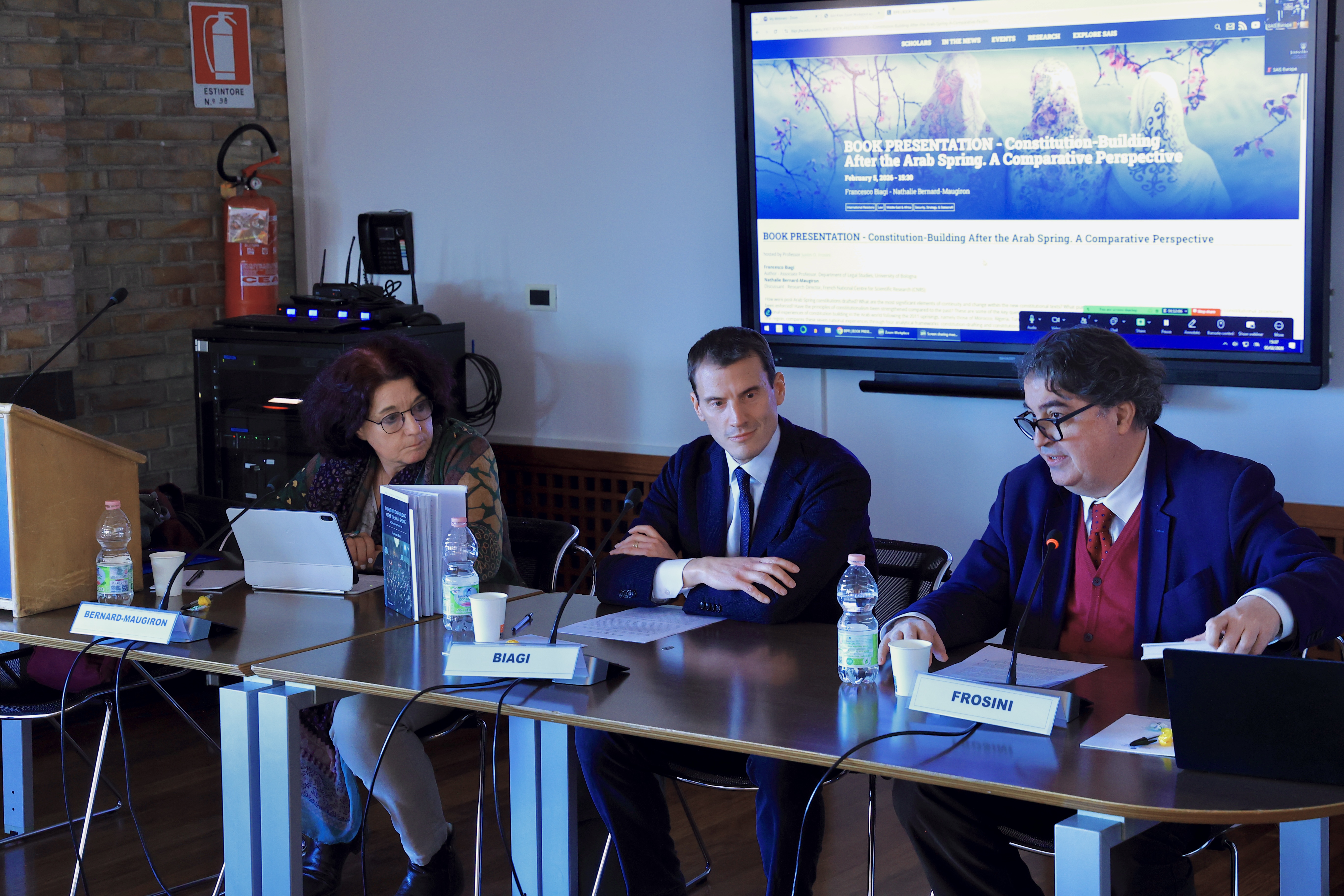
The event on February 5th, introduced by Professor Justin Frosini, featured a presentation by Francesco Biagi on his recent book Constitution-Building After the Arab Spring, followed by critical reflections by Nathalie Bernhard-Maugiron. The discussion centered on constitutional transformation in the Arab world after the 2011 uprisings and its broader relevance for comparative constitutional scholarship.
Biagi explained that the book is the result of over a decade of engagement in the Arab region through academic research, consultancy, and training activities for governmental and judicial institutions. Much of this work was conducted in cooperation with the Max Planck Foundation, alongside projects with the CCSDD. A key strength of the book lies in its dual approach, combining academic analysis with hands-on experience on the ground. This allowed the author to bridge theory and practice in examining constitution-building processes.
The motivation for the book is threefold. First, Biagi argued that the Arab region remains underexplored in comparative constitutional studies, despite its rich and complex constitutional experiences. Second, countries such as Egypt, which has adopted multiple constitutions in a short period, illustrate why the region is particularly relevant for constitutional scholarship. Third, constitution-building in the Arab world has involved a wide range of international actors, including the United Nations in cases such as Syria and Libya, adding another important layer to these processes.
The book adopts a comparative and interdisciplinary perspective, analyzing seven countries: Morocco, Algeria, Libya, Jordan, Egypt, Tunisia, and Syria. Francesco Biagi conceptualizes constitution-building as consisting of three main components: drafting and writing, substantive constitutional choices, and enforcement or implementation. The comparative approach is used to identify regional trends after the Arab uprisings, while also accounting for the intersection of law, politics, and religion, which often operate together rather than separately, as illustrated by cases such as Morocco.
The first chapter examines variables shaping constitution-drafting processes, including the role of civil society, the duration of drafting, and the influence of foreign constitutional models. Francesco identified significant shortcomings in many of these processes, which contributed to weak legitimacy and fragile constitutional outcomes. The second chapter focuses on systems of government and the distribution of power, finding that most post-2011 constitutions continue to concentrate power in the hands of the head of state. Tunisia stands out as an exception due to its stronger checks and balances, although constitutional courts across the region play an uneven role in enforcement.
Another key chapter explores the relationship between citizenship and religion, with particular attention to women and non-Muslims as the most vulnerable groups. While exclusion persists, Francesco highlighted a frequently overlooked constitutional tension between integration and fragmentation, both written and unwritten. The Tunisian experience between 2011 and 2021 demonstrated that a break from authoritarianism was possible, even if ultimately reversed.
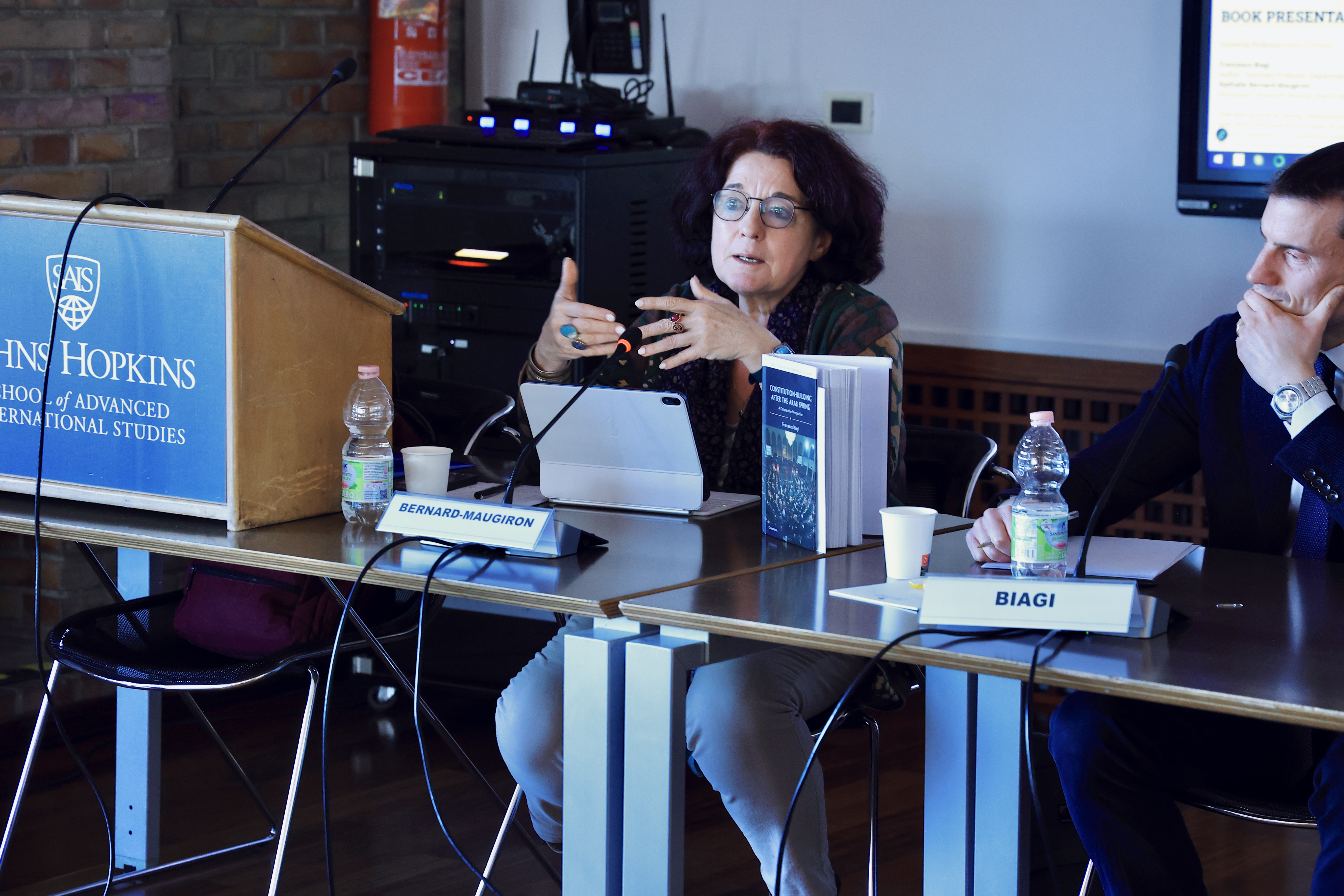
Following the presentation, Nathalie Bernhard-Maugiron's remarks situated the book in the context of the Arab Spring's fifteen-year legacy. She emphasized the concept of "constitutions without constitutionalism," noting that many Arab constitutions fail to limit power or protect rights in practice. She praised the book's focus on process quality, contrasting bottom-up, inclusive approaches such as Tunisia's with elite-driven, top-down models in Morocco and Jordan. While Tunisia's process was the most democratic, she questioned whether consensus-based constitution-making produced ambiguity and fragility, contributing to its eventual collapse.
Finally, Nathalie Bernhard-Maugiron underscored one of the book's central contributions: challenging the tendency to view Arab constitutions primarily through the lens of religion. Instead, the core issue is power concentration, an inherently universal problem rather than one unique to the Arab world.
Event Photos
BOOK PRESENTATION - Constitution-Building After the Arab Spring. A Comparative Perspective
hosted by Professor
Justin O. Frosini
Francesco Biagi
Author - Associate Professor, Department of Legal Studies, University of Bologna
Nathalie Bernard-Maugiron
Discussant - Research Director, French National Centre for Scientific Research (CNRS)
How were post-Arab Spring constitutions drafted? What are the most significant elements of continuity and change within the new constitutional texts? What purposes are these texts designed to serve? To what extent have constitutional provisions been enforced? Have the principles of constitutionalism been strengthened compared to the past? These are some of the key questions Francesco Biagi addresses.
Constitution Building After the Arab Spring. A Comparative Perspective examines seven national experiences of constitution building in the Arab world following the 2011 uprisings, namely those of Morocco, Algeria, Tunisia, Libya, Egypt, Syria, and Jordan. This interdisciplinary book, based largely on the author's own work and research in the region, compares these seven national experiences through four analytical frameworks: constitution-drafting and constitutional reform processes; separation of powers and forms of government; constitutional justice; and religion, women and non-Muslims within the framework of citizenship.
FRANCESCO BIAGI Francesco Biagi is Associate Professor of Comparative Public Law in the Department of Legal Studies of the University of Bologna, Deputy Secretary General of the International Association of Constitutional Law (IACL-AIDC), and Research Fellow at the Center for Constitutional Studies and Democratic Development (a partnership between the Johns Hopkins University SAIS Europe and the University of Bologna). From October 2015 to January 2017, he was Senior Research Fellow at the Max Planck Foundation for International Peace and the Rule of Law (Heidelberg), where he now serves as a legal consultant.
Biagi has been Visiting Professor at the University of Illinois College of Law (regularly since 2015) and the Tel Aviv University Faculty of Law (2022), as well as Adjunct Professor at the Dickinson College (2025). He carried out periods of study and research at the Cardozo School of Law (New York City), the Central European University (Budapest), the Universidad del País Vasco (Bilbao), and the Instituto de Investigaciones Jurídicas of the Universidad Nacional Autónoma de México (Mexico City). He is member of the Advisory Board of the Max Planck Encyclopedia of Comparative Constitutional Law (Oxford University Press) .
Since 2013 he has provided trainings and consultancies – on various projects related to constitution-building and the rule of law – to governmental and judicial institutions in Sub-Saharan Africa (especially in Somalia), Middle East and North Africa (especially in Morocco, Jordan and Palestine), and Latin America (where he provided technical assistance during the 2022 and 2023 constitution-drafting processes in Chile).
Biagi has written extensively in English, Italian and Spanish on transition processes, constitution-building, forms of government, constitutional justice, fundamental rights, electoral justice, hybrid and illiberal regimes, Arab constitutional systems. He is the author o f two monographs:
Constitution-building after the Arab Spring. A Comparative Perspective (Cambridge University Press 2025), and
European Constitutional Courts and Transitions to Democracy (Cambridge University Press 2020). His latest publications include
Comparative Constitutional History. Volume 2: Uses of History in Constitutional Adjudication (edited with J.O. Frosini and J. Mazzone, Brill, 2023); "Insegnare diritto comparato in inglese. Sfide e prospettive", 3 Diritto pubblico comparato ed europeo (2024); "La neutralización de los Tribunales constitucionales en los regímenes populistas-iliberales: un análisis a partir de los casos de Hungría y Polonia", 116
Revista de Derecho politico (2023). "Constitution Drafting After the Arab Spring. A Comparative Overview", 29
Indiana Journal of Global Legal Studies 1 (2022); "Foreign Law in Constitutional Interpretation", in R. Wolfrum, R. Grote, F. Lachenmann (eds.),
The Max Planck Encyclopedia of Comparative Constitutional Law (Oxford University Press 2021). .
Biagi obtained a PhD in Constitutional Law from the University of Ferrara after graduating in Law from the University of Bologna (magna cum laude).
NATHALIE BERNARD-MAUGIRONNathalie Bernard-Maugiron is a senior researcher at the French National Research Institute for Sustainable Development (IRD). She holds a PhD in Public Law from the University of Paris and specializes in constitutional and legal transformations in the Arab world, with a particular focus on Egypt. She has taught at Cairo University, the American University in Cairo, Sorbonne University, EHESS, and Sciences Po Paris, and has served as co-director of the Institut d'études de l'Islam et des sociétés du monde musulman (IISMM) at the EHESS (École des hautes études en sciences sociales) in Paris. She is currently an associate researcher at Université Paris Cité and a lecturer in Middle Eastern Law at Sciences Po Paris. She is the author of
Droit contemporain des pays arabes (Sirey/Dalloz, 2023).