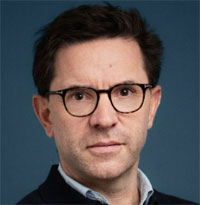
Bio
Justin Vaisse is James Anderson Professor of American Foreign Policy at SAIS Europe
Justin Vaïsse is James Anderson Professor of American Foreign Policy at the Johns Hopkins University School of Advanced International Studies (SAIS), teaching at the Europe Center in Bologna, and a non-resident Senior Fellow at the Henry A. Kissinger Center for Global Affairs at SAIS in Washington, DC.
From 2019 to 2026, he was Director General of the Paris Peace Forum, an independent non-profit organization he created in 2018 under the impetus of French President Emmanuel Macron to bring solutions to the most pressing global governance challenges of our time. He still serves as President of the Paris Peace Forum Endowment Fund.
Prior to that role, he was Director of Policy Planning at the French Ministry of Foreign Affairs for more than 6 years. In this role, he advised the Minister and the President on strategic decisions and provided background analysis and forecast on international affairs. From 2007 – 2013, Justin Vaïsse was Director of Research for the Center on the United States and Europe and a Senior Fellow in Foreign Policy at the Brookings Institution in Washington DC.
A historian specializing in international relations and American foreign policy, Dr. Vaïsse is the author or co-author of numerous books on the United States, including
Neoconservatism – The Biography of a Movement (Harvard University Press, 2010), a book deemed “essential reading for anyone wishing to understand the contours of our recent political past” by the New York Times. His biography of former National Security Adviser Zbigniew Brzezinski was published in France in 2016, in the US in 2018 under the title
Zbigniew Brzezinski – America’s Grand Strategist (Harvard University Press) and in several other countries.
A graduate student from L'Ecole Normale Supérieure and Sciences Po, he got his Agrégation in history in 1996, his Ph.D. in 2005 and his habilitation in 2011. He was a teaching assistant at Harvard University in 1996-1997 and an adjunct professor at Sciences-Po from 1999-2006 and at the School of Advanced International Studies (SAIS) at Johns Hopkins University from 2007-2013.
Courses
- Leadership, Ethics and Decision-Making
This course will expose students to the theory and practice of leadership, ethics, and decisionmaking in the realm of statecraft. We will take an immersive and practice-focused approach, wrestling with past and present policy challenges as a means to understand and internalize the struggle of policymakers trying to make and implement good decisions. Given that students will not vault immediately to the upper echelons of leadership upon graduation, we will take up the challenges that confront more junior and mid-level policymakers as well as senior officials. Our case studies will encompass historical successes and failures as well as simulations and exercises in which students will be forced to stand in the uncomfortable shoes of decisonmakers facing no-win dilemmas. By the course’s end, students will have sharpened their skills of analysis, judgment, collaboration, decisionmaking, and presentation. They will have formed preliminary views on the following fundamental questions and be positioned to take these lessons forward into their careers.
- Interpreting American Foreign Policy: Ideas, History, and Practice
Bordered by oceans and friendly neighbors, America combines benign geopolitical constraints with great economic power. As a result, its foreign policy can range from isolation to global domination. This unusual situation calls for a multiplicity of approaches to interpreting its foreign policy, and for paying special attention to the role of ideas in decision-making.
To navigate this complexity, the course is structured around three complementary objectives. First, it will explore or revisit the basic elements of the historical record and the decision-making mechanisms in American diplomacy. Second, it will examine the major historical and theoretical interpretations of U.S. global engagement, ranging from imperialism and cyclical movements to economic, sectional and cultural approaches. Third, students will contribute to an exercise in mapping contemporary American foreign policy debates in order to gain a deeper understanding of how Washington works.
By marrying institutional practice, intellectual history, and critical analysis with the granular exploration of contemporary debates in the Trump era, this course equips students to understand how American foreign policy is imagined, constructed, and executed on the world stage.